Am I Burned Out or Just Overwhelmed? Signs You Need to Slow Down
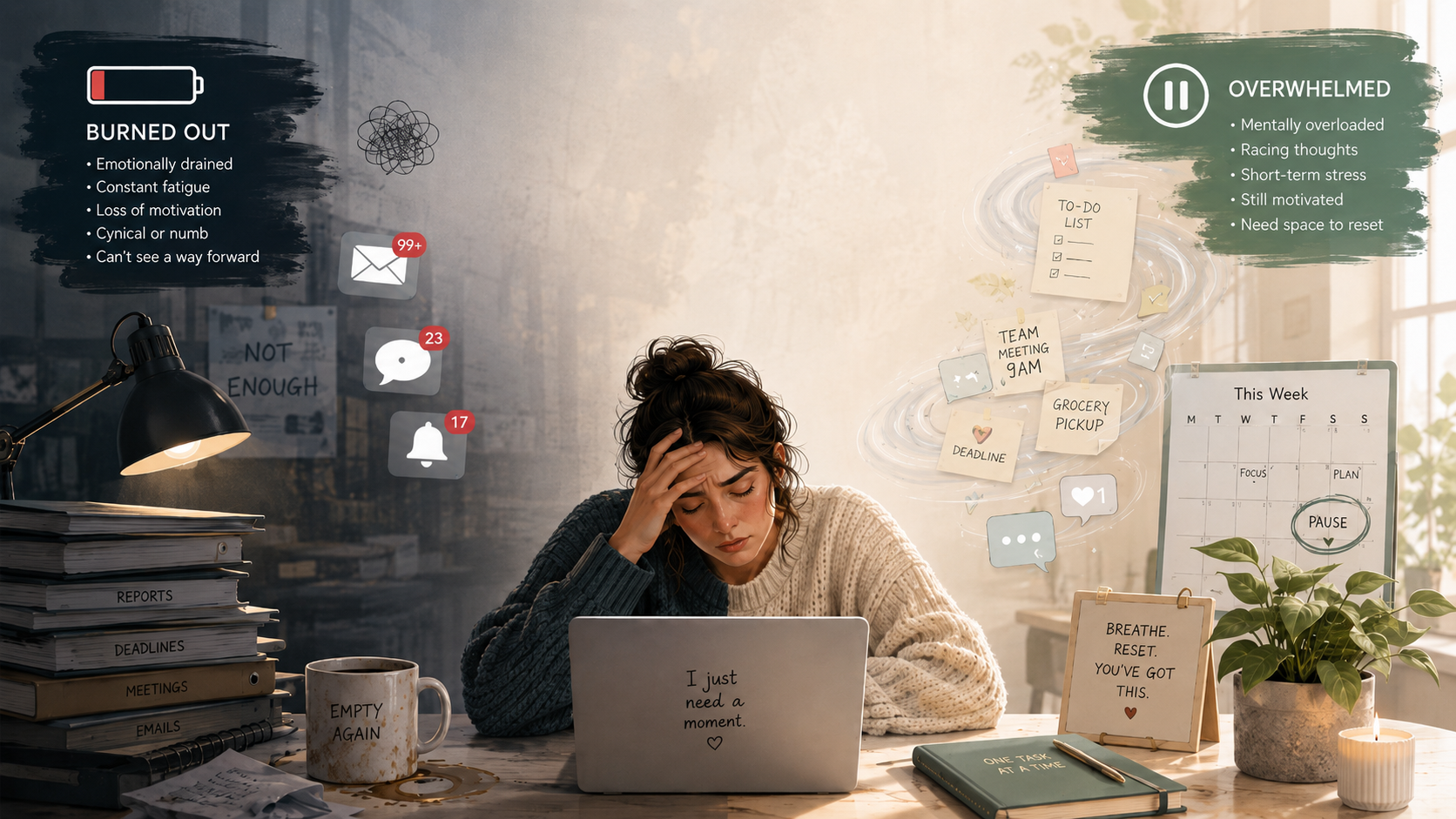
Some days feel heavy.
Your inbox is full. Your brain will not switch off. Small tasks feel bigger than they should. You keep telling yourself, “I just need to get through this week,” but the next week feels exactly the same.
That is when the question starts to appear:
Am I burned out, or am I just overwhelmed?
The difference matters. Feeling overwhelmed usually means you are carrying too much right now. Burnout is deeper. It often comes from ongoing stress that has not been resolved, especially work-related stress. The World Health Organization describes burnout as an occupational phenomenon linked to chronic workplace stress, with signs including exhaustion, mental distance from work, cynicism, and reduced professional effectiveness.
This blog post will help you understand the difference, spot the warning signs, and decide whether your mind and body are asking you to slow down.
You can use the links below to navigate to any section of this article:
Pause and Reflect
Before trying to label what you are feeling, take a moment to notice what has been happening for you lately.
Ask yourself:
Do I feel overloaded by what is happening right now?
Do I feel like there is too much to manage at once?
Am I struggling to decide what to do first?
Has this feeling been building for weeks or months?
Do I feel tired even after resting?
Am I still able to enjoy things, or do I feel emotionally flat?
Have I felt like myself recently?
Am I pushing through because I feel I have no other choice?
You do not need to have all the answers straight away.
Sometimes the first step is simply recognising whether you feel temporarily overloaded, deeply depleted, or somewhere in between.
What Is Burnout?
Burnout is a state of deep emotional, mental, and physical exhaustion.
It can happen when stress has gone on for too long and your usual ways of coping no longer feel enough. You may notice that you are not just tired, but drained. Rest may help for a short time, but it does not fully restore you.
Burnout can affect how you feel, think, and respond to daily life. You might become more distant, less motivated, more irritable, or less able to care in the way you normally would.
The World Health Organization links burnout to ongoing workplace stress that has not been successfully managed. It is often associated with exhaustion, feeling mentally distant or cynical about work, and finding it harder to function effectively.
Although burnout is often connected to work, similar feelings can also come from caregiving, parenting, studying, relationship strain, financial pressure, or always feeling responsible for others.
Burnout can sound like:
“I have nothing left to give.”
“I cannot keep doing this.”
“Even rest does not seem to help.”
“I do not feel like myself anymore.”
Burnout is not a personal failure. It is usually a sign that something has become unsustainable and needs care, support, or change.
Common Signs of Burnout
Burnout can look different from person to person. For some, it feels like exhaustion. For others, it shows up as irritability, numbness, low motivation, or feeling unable to keep up.
Some common signs include:
-
This is more than ordinary tiredness. Burnout-related exhaustion can feel physical, mental, and emotional.
You may sleep, take time off, or have a quiet evening, but still wake up feeling drained. Even basic tasks may start to feel like they require more energy than you have.
You might also notice that you need more time alone, rely more on caffeine, or feel like you are pushing yourself through the day.
-
Burnout can make it harder to feel connected to work, relationships, responsibilities, or even yourself.
Things that used to matter may feel pointless. You may feel numb, distant, cynical, or unable to emotionally engage in the way you normally would.
You may notice thoughts like:
“I just do not care anymore.”
“Everyone wants something from me.”
“I cannot deal with another problem.”
“I want to be left alone.”This detachment can be your mind’s way of trying to protect you from further emotional overload.
-
Burnout can make small requests feel unbearable.
You may feel frustrated when people need something from you, even if you care about them. You may feel resentful that others do not seem to notice how much you are carrying.
You might also find yourself becoming more negative, impatient, or cynical than usual.
This does not mean you are a bad person. It may mean you have been giving from a place of depletion for too long.
-
Burnout can affect your sense of drive.
Tasks you used to manage may feel pointless, difficult, or impossible to start. You may procrastinate more, avoid responsibilities, or feel unable to complete simple things.
This can create shame, especially if you are used to being capable, organised, or dependable.
But burnout is not laziness. It is often a sign that your system is overloaded and under-recovered.
-
Burnout can affect concentration, memory, decision-making, and productivity.
You may make mistakes you would not normally make. You may miss deadlines, forget details, or need much longer to complete tasks.
You may also find it harder to be creative, patient, present, or emotionally available.
-
Many people describe burnout as feeling disconnected from who they used to be.
You may feel less patient, less hopeful, less interested, less social, or less emotionally available. You may wonder why you cannot simply “snap out of it.”
This can feel unsettling, but it can also be useful information. Something in your life may need care, support, rest, or change.
These signs do not always mean you are burned out, but they can be a signal that something in your life needs attention.
If several of them feel familiar, it may be worth pausing to ask what has been taking too much from you, and what kind of support, rest, or change you may need.
What Does It Mean to Feel Overwhelmed?
Feeling overwhelmed usually means the demands on you feel greater than your current capacity.
You may still care about your work, relationships, responsibilities, or goals, but everything feels like too much at once. Your mind may feel crowded. Your body may feel tense. Your emotions may feel close to the surface.
Overwhelm often sounds like:
“I do not know where to start.”
“There is too much to do.”
“I cannot keep up.”
“Everything feels urgent.”
“I just need things to stop for a moment.”
Overwhelm is often connected to the present moment. There may be too many tasks, decisions, messages, responsibilities, emotions, or pressures competing for your attention.
Unlike burnout, overwhelm may ease when the pressure reduces, priorities become clearer, or you receive support.
That does not mean overwhelm is not serious. If overwhelm continues for too long without rest or support, it can contribute to deeper emotional and physical exhaustion.
Common Causes of Overwhelm
Overwhelm can come from one major stressor or from many smaller pressures building up at once.
Common causes include:
A heavy workload
Too many deadlines
Financial pressure
Family responsibilities
Caregiving responsibilities
Relationship difficulties
Health worries
Constant decision-making
Lack of support
Poor sleep
Major life changes
Conflict at work or home
Feeling responsible for everyone
Having little time to recover
Trying to meet unrealistic expectations
Sometimes overwhelm is not about one obvious problem. It may come from the constant accumulation of demands.
You may be able to cope with work stress on its own. You may be able to cope with family responsibilities on their own. You may be able to cope with emotional stress on its own.
But when everything happens together, your capacity can become stretched.
Common Signs of Overwhelm
Overwhelm can be easy to dismiss as “just being busy,” but it often shows up in small changes to your focus, emotions, and ability to manage everyday demands.
Some common signs include:
-
When everything feels important, it can become difficult to prioritise.
You may jump between tasks without finishing them, spend more time thinking about what needs to be done than actually doing it, or freeze because choosing one thing means temporarily ignoring everything else.
This can happen when your mind is trying to hold too much at once.
-
Overwhelm can make emotions feel harder to manage.
You may cry more easily, snap at people, feel panicky, or become frustrated by small inconveniences. Your reactions may feel bigger than the situation in front of you.
This does not mean you are overreacting. It may mean you are already carrying too much.
-
Overwhelm can create mental loops.
You may replay conversations, plan future tasks, worry about what you have forgotten, or mentally rehearse everything that could go wrong.
This can feel like problem-solving, but it often leaves you more exhausted.
-
Avoidance is common when something feels overwhelming.
You may ignore emails, delay decisions, avoid messages, put off appointments, or distract yourself because facing everything feels impossible.
Avoidance can bring short-term relief, but it often increases stress later.
-
Overwhelm often shows up in the body.
You may notice headaches, tight shoulders, jaw tension, stomach discomfort, shallow breathing, restlessness, fatigue, or sleep problems.
Physical symptoms can have many causes, so it is important to seek medical advice if they are persistent, severe, or concerning.
These signs do not always mean something is wrong, but they can suggest that your mind and body are trying to manage more than feels comfortable right now.
If several of these feel familiar, it may be worth asking what can be simplified, paused, shared, or supported.
Burnout vs Overwhelm: The Key Difference
The simplest way to understand the difference is this:
Overwhelm is usually about too much happening right now.
Burnout is usually about too much happening for too long.
When you are overwhelmed, your system may feel overloaded by the demands in front of you. You might still care, still feel motivated, and still want to do things well, but everything feels like it is asking for your attention at once.
Burnout tends to go deeper. It often builds after a long period of stress, pressure, or emotional strain. Instead of feeling overloaded, you may feel depleted, detached, numb, or unable to care in the way you used to.
Overwhelm can feel like:
“This is too much for me to manage right now.”
Burnout can feel like:
“I do not have enough left to keep going like this.”
Both are signs that your capacity needs attention. The difference is often the depth, duration, and impact of what you are experiencing. Overwhelm may ease when pressure is reduced, support is added, or priorities are made clearer. Burnout often needs deeper recovery, stronger boundaries, and meaningful change.
Can Overwhelm Turn Into Burnout?
Yes, ongoing overwhelm can contribute to burnout if it continues without enough rest, support, or change.
Short periods of stress are a normal part of life. There may be times when you have to manage more than usual, such as during a deadline, transition, family difficulty, or major life event.
But when overwhelm becomes your normal state, your body and mind may not get enough time to recover. Over time, this can wear down your energy, motivation, and emotional capacity.
You may start to notice:
Emotional exhaustion
Reduced motivation
Detachment
Resentment
Poor concentration
Sleep difficulties
Physical tension
Lower capacity to cope
Feeling unable to continue as before
This is why it can be helpful to notice overwhelm early. You do not have to wait until you are completely burned out before taking your needs seriously.
Needing support is not a sign that you have failed. It is often a sign that something has been too much for too long.
A Quick Moment of Reflection
Take a slow breath and ask yourself:
What am I carrying right now that feels too heavy?
You might think of a task, a relationship, a responsibility, an expectation, or an emotion you have not had space to process.
Then ask:
Is this a short-term pressure, or has this been building for a long time?
If it is short-term, you may need immediate relief, clearer priorities, and practical support.
If it has been building for a long time, you may need deeper recovery, stronger boundaries, and a closer look at what has become unsustainable.
You do not need to solve everything today.
But noticing the difference is a meaningful place to start.
Signs You Need to Slow Down
You may need to slow down if your body, mind, or emotions are repeatedly signalling that your current pace is not sustainable.
Signs may include:
You wake up tired most days
You feel emotionally numb or detached
You are more irritable than usual
You feel guilty whenever you rest
You struggle to concentrate
You avoid messages, tasks, or people
You feel anxious when you are not being productive
You no longer enjoy things that usually help you feel well
You keep saying, “Once this week is over, I will rest,” but rest never comes
You feel resentful of people who need you
You are relying more on caffeine, sugar, alcohol, scrolling, or other coping habits
Your sleep, appetite, or mood has changed
You feel like you are functioning, but not really living
Slowing down does not always mean stopping everything.
It may mean doing fewer things. It may mean asking for help. It may mean taking breaks before you reach breaking point. It may mean being honest about what is no longer manageable.
Sometimes slowing down is not a luxury. It is a necessary response to what your mind and body have been trying to communicate.
How Therapy Can Help With Burnout and Overwhelm
Therapy can offer a calm, supportive space to explore what has been happening beneath the surface.
When you are burned out or overwhelmed, it can be difficult to think clearly. You may blame yourself, minimise your needs, or feel stuck in survival mode. Therapy can help you slow the process down and understand what is contributing to your stress.
Therapy may help you:
Identify patterns that lead to burnout
Understand what triggers overwhelm
Explore guilt around rest or boundaries
Recognise unrealistic expectations
Process emotional exhaustion
Develop healthier coping strategies
Practise saying no
Rebuild a sense of choice and control
Understand the difference between responsibility and over-responsibility
Make decisions about what needs to change
For some people, therapy is not only about coping better. It is about learning why they feel they must keep coping in the first place.
You might explore questions such as:
Why do I find it hard to stop?
What do I believe will happen if I disappoint someone?
Where did I learn that rest has to be earned?
Why do I feel responsible for everything?
What would a more sustainable life look like?
Burnout and overwhelm are not just time-management problems. They are often connected to boundaries, identity, relationships, self-worth, fear, pressure, and unmet needs.
Therapy can help you understand these connections with more compassion.
When It Might Help to Seek Support
It may help to seek support if your stress, exhaustion, or overwhelm is starting to affect your daily life.
You do not need to wait until things feel unbearable.
Consider reaching out for support if:
You feel exhausted most of the time
Rest does not seem to help
You feel persistently anxious, low, numb, or hopeless
You are withdrawing from people
You are struggling to keep up with daily responsibilities
You feel unable to make decisions
You are experiencing frequent physical symptoms of stress
You feel trapped in your current situation
You are relying on unhealthy coping strategies
You feel like you no longer recognise yourself
If you are having thoughts of harming yourself, feel unable to stay safe, or feel at risk, seek urgent support immediately through local emergency services, a crisis line, or your nearest emergency department.
Support does not mean you have failed. It means you are no longer trying to carry everything alone.
Final Thoughts
Being overwhelmed does not mean you are weak.
Being burned out does not mean you have failed.
Both can be signs that something in your life needs attention, care, support, or change.
Overwhelm may be telling you that your current load is too heavy. Burnout may be telling you that you have been carrying too much for too long.
You do not have to earn rest by reaching breaking point.
Sometimes the most important thing you can do is pause, listen to what your body and mind are telling you, and take one honest step toward support.
About the Author
I’m Amber Sexton, BSc (Hons), a counsellor and psychotherapist in private practice. I offer a safe, non-judgemental space where you can explore what you’re going through at your own pace. Everyone deserves to be heard and supported, and I believe no one should have to suffer in silence.
Hand in Hand Therapy | Face-to-face in Epsom and online across the UK and worldwide.