Performance Anxiety at Work or School: Why It Happens and How to Manage It
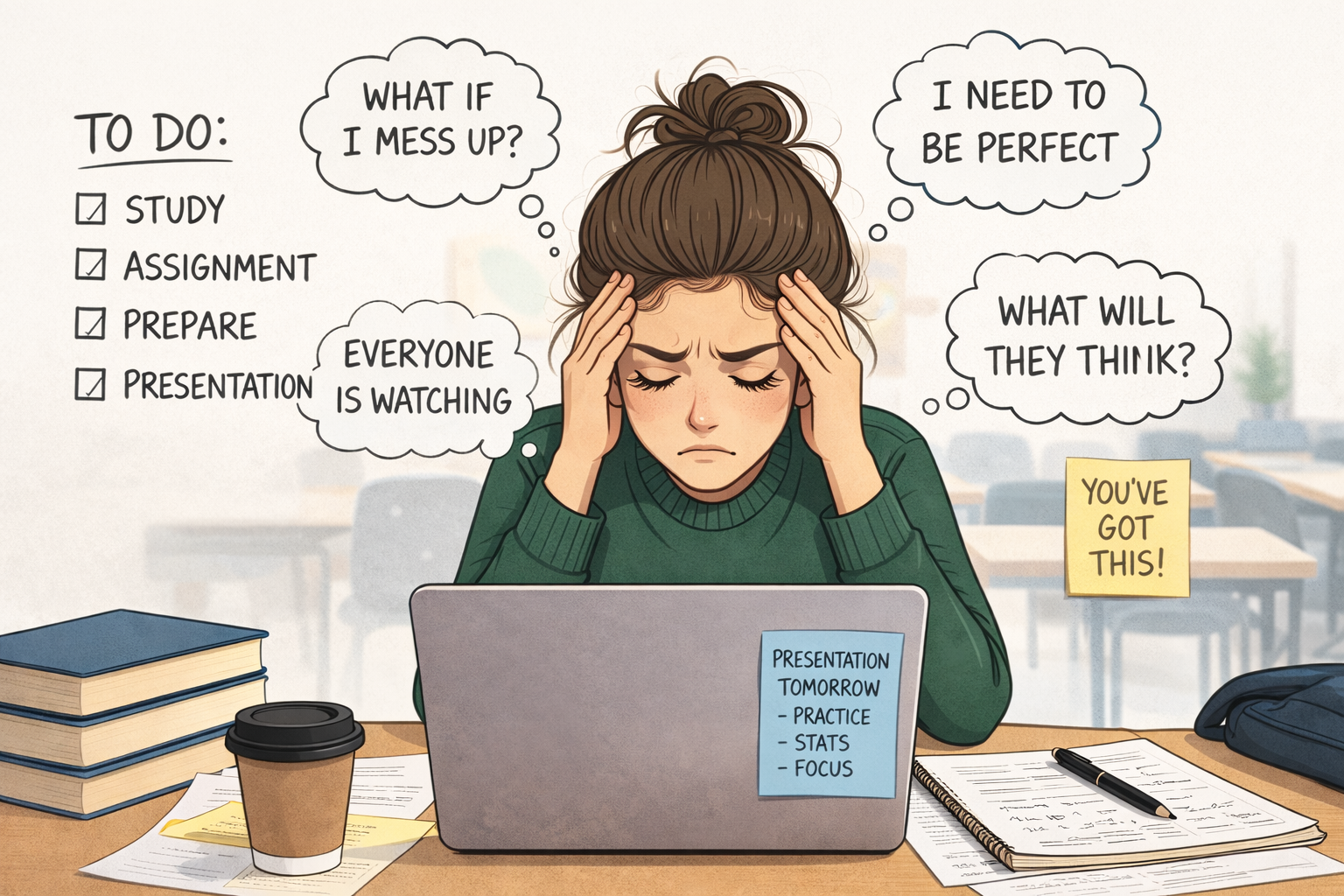
Performance anxiety is something most people experience at some point—whether it’s delivering a presentation, sitting an exam, meeting deadlines, or being evaluated by others. While a certain level of pressure can motivate you, too much can quickly become overwhelming, affecting both your performance and wellbeing.
If you’re unsure whether what you’re experiencing is anxiety or stress, you can read my blog post Anxiety vs Stress: What’s the Difference?
As a therapist, I often see how this anxiety is not just about the task itself, but about what the task represents—fear of judgment, fear of getting it wrong, or the pressure to meet expectations. Alongside practical strategies, it’s important to also acknowledge the internal experience that comes with it.
Because these situations are often part of everyday life, performance anxiety can be easy to dismiss or push through. However, when it becomes persistent, it can start to impact confidence, focus, and overall wellbeing.
If you’ve ever felt overwhelmed before an important task, struggled with self-doubt under pressure, or noticed yourself overthinking your performance, this blog will help you understand why this happens and how to manage it more effectively.
You can use the links below to navigate to any section of this article:
What Is Performance Anxiety?
Performance anxiety is a common form of anxiety that involves fear or worry about being judged, failing, or not meeting expectations in situations where your performance is being evaluated. This can occur at work, in school, or in any setting where you feel under pressure to perform well.
If you’d like a broader understanding of anxiety, including its causes, symptoms, and treatment options, you can read my blog post What Is Anxiety? Causes, Symptoms, and Treatment Options.
It can show up physically (racing heart, sweating, tension), mentally (negative thoughts, self-doubt, difficulty concentrating), or emotionally (fear, frustration, irritability).
While it’s often linked to specific events—such as presentations, exams, or interviews—performance anxiety is not just about the situation itself. It is also shaped by how we interpret that moment. For many people, it can feel as though their ability, competence, or even self-worth is being evaluated, which can intensify the pressure and make the experience more overwhelming.
You might notice common signs of performance anxiety, including:
Overthinking before, during, or after the event
Difficulty focusing or “going blank” under pressure
Increased self-criticism or a harsh internal dialogue
Avoidance of situations where you may be judged or evaluated
Replaying situations afterwards and focusing on perceived mistakes
From a therapeutic perspective, performance anxiety can be linked to underlying patterns such as perfectionism, fear of failure, or a strong need for approval. These patterns often develop over time and can make everyday situations—like speaking in meetings or completing tasks under deadlines—feel more high-stakes than they are.
Understanding performance anxiety in this way can help reframe it—not as a personal weakness, but as a natural response shaped by both psychological and physiological factors.
Why Performance Anxiety Happens
At its core, it is tied to the “fight or flight” response. When your brain perceives a situation as threatening—even if it’s social or professional pressure—it releases stress hormones like adrenaline. In some cases, this response can feel intense or overwhelming, and may even resemble a panic response. If you’d like to explore this further, you can read my blog post Understanding Panic Attacks: How to Manage Them and What Helps Long Term.
This response can:
Increase alertness (helpful in moderation)
Impair memory and concentration (when excessive)
Lead to overthinking or panic
When this response is activated, the brain is prioritising survival over performance. This means it becomes harder to think clearly, recall information, or stay focused—despite how important the task may be. This is why people often describe “going blank” or feeling mentally stuck under pressure.
Alongside this biological response, there is often a psychological layer—beliefs about needing to perform perfectly, fear of making mistakes, or concerns about how we will be perceived by others. Past experiences, such as criticism, high expectations, or feeling judged, can also shape how strongly this response is triggered.
For some, this can create a cycle:
Anticipating the situation leads to worry and tension
The body becomes more alert and reactive
The experience feels overwhelming in the moment
Afterwards, there may be overthinking or self-criticism
Over time, this cycle can reinforce anxiety, making future situations feel even more pressured. It can also become more noticeable in the evening or at night, when there are fewer distractions and the mind has more space to replay situations, worry about what happened, or anticipate what might happen next. You can read more about this in Why Anxiety Feels Worse at Night.
Understanding this can be reassuring—it highlights that what you’re experiencing is not a lack of ability, but a natural response from both the body and mind when something feels important or at risk.
Common Triggers of Performance Anxiety
Performance anxiety tends to arise in situations where you feel observed, evaluated, or under pressure to meet expectations—especially when the outcome feels important.
Common triggers include:
Public speaking or presentations
Exams or academic assessments
Job interviews or performance reviews
Tight deadlines or high workloads
Being observed, monitored, or evaluated by others
Situations where the outcome feels important or high-stakes
New or unfamiliar environments where expectations are unclear
Tasks where there is a fear of making mistakes or being criticised
These situations can trigger not only immediate stress, but also deeper concerns around judgment, competence, and self-worth. When something feels high-stakes, the mind can quickly shift into “threat mode,” even if there is no real danger present.
In these moments, you may notice increased pressure to perform perfectly, heightened self-awareness, or a tendency to overanalyse your actions. This can make even familiar situations feel more intense or overwhelming than usual.
Over time, repeated exposure to these triggers—especially without support or understanding—can reinforce patterns of anxiety, avoidance, or self-doubt. Recognising your personal triggers is an important first step in understanding your response and beginning to manage it more effectively.
Reflection: Understanding What Feels at Stake
Before moving into strategies, it can be helpful to pause and understand what may be sitting underneath this experience.
As you read this, you might already have a specific situation in mind—an upcoming presentation, an exam, a deadline, or a moment where you feel under pressure. Taking a moment to reflect can help you better understand your experience of performance anxiety in that context.
Rather than trying to push the feeling away, this is an opportunity to get curious about what might be underneath it.
You might consider:
In the situation I’m thinking about, what actually feels at risk for me?
Am I more concerned about the outcome itself, or what that outcome might mean about me?
What am I telling myself about how I need to perform?
Am I holding myself to a standard of being perfect or not making mistakes?
If things didn’t go as planned, what do I imagine would happen next?
How would I respond to someone else in this same situation?
What is within my control here—and what isn’t?
There are no right or wrong answers here—just an opportunity to notice patterns in your thoughts and expectations. Even a small amount of awareness can help create space between you and the anxiety, making it easier to respond in a more balanced and supportive way.
Simple Ways to Stay Calm Under Pressure
When performance anxiety shows up, it can help to focus on simple, realistic ways to steady yourself. These aren’t about getting rid of anxiety completely, but about making it feel more manageable.
The aim isn’t to feel completely calm or confident, but to feel steady enough to get through the moment. Even a small shift—in your focus, your breathing, or how you respond to your thoughts—can help make the experience feel more manageable and less consuming.
You might find it helpful to try some of the following:
1. Prepare Enough, Then Stop
Being prepared can help you feel more confident—but there’s a point where more preparation just adds pressure. Aim to feel ready, rather than perfectly prepared.
You might find it helpful to:
Set a simple limit for how long you prepare
Focus on key points rather than trying to cover everything
Remind yourself when you’ve done enough
Trusting that you’ve prepared sufficiently can help reduce pressure and allow you to approach the situation more calmly.
2. Notice Your Self-Talk
Pay attention to how you’re speaking to yourself. If your thoughts are harsh or overly critical, try to soften them slightly—something more realistic and supportive can make a difference.
You might find it helpful to:
Notice when your thoughts become overly negative or self-critical
Gently question whether those thoughts are completely accurate
Shift towards something more balanced, rather than overly positive
Even small changes in how you speak to yourself can reduce pressure and make situations feel more manageable.
3. Slow Things Down
When anxiety builds, everything can start to feel rushed. Slowing your breathing, your speech, or even your movements can help your body settle.
You might find it helpful to:
Take a slightly slower breath in and out
Pause briefly before responding or continuing
Speak or move at a more steady pace
Slowing things down can help reduce the intensity of the moment and give you a greater sense of control.
4. Take It One Step at a Time
Instead of thinking about the whole situation, focus on what’s right in front of you—one question, one sentence, one task at a time.
You might find it helpful to:
Bring your attention back to the next small step
Focus on what you’re doing right now, rather than what’s coming next
Gently redirect your mind if it starts jumping ahead
Breaking things down in this way can make the situation feel more manageable and reduce the sense of overwhelm.
5. Let Go of Getting It Perfect
Most people don’t perform perfectly—and they don’t need to. Allowing for small mistakes can take some of the pressure off.
You might find it helpful to:
Remind yourself that “good enough” is often enough
Notice when you’re holding yourself to unrealistic standards
Allow small mistakes without over-focusing on them
Letting go of perfection can reduce pressure and help you stay more present in the moment.
6. Don’t Avoid It Completely
It’s natural to want to avoid situations that make you anxious, but avoiding them can make things feel harder over time. Facing them gradually can help build confidence.
You might find it helpful to:
Start with smaller or less intense situations
Take things at your own pace
Acknowledge each step you take, even if it feels small
7. Look After the Basics
Things like sleep, eating regularly, and getting some movement can have a bigger impact on how you handle pressure than you might expect.
You might find it helpful to:
Prioritise rest where you can
Keep a regular routine around meals
Build in some form of movement, even if it’s light
Looking after the basics can help your body feel more steady and better able to cope with pressure.
These approaches can help in the moment, but if performance anxiety is something you struggle with regularly, it can be helpful to explore it more deeply and understand what’s driving it beneath the surface.
If you’d like support with this, you can book a session with me to explore your experience in a more personalised and in-depth way.
What to Do in the Moment
If anxiety shows up during a performance, it can feel intense and hard to manage. In these moments, the focus is on getting through it, rather than trying to feel completely calm.
You might try:
Pause briefly—it’s okay to take a moment before continuing
Take one slower breath in and out
Bring your focus back to the next small step
Gently ground yourself by noticing your surroundings
Remind yourself: “This will pass”
These small actions won’t remove anxiety completely, but they can help take the edge off and allow you to keep going.
When to Seek Support
If performance anxiety is persistent or starting to impact your confidence, work, or day-to-day life, it may be helpful to explore it in a more supported way.
For some people, this can also show up as high-functioning anxiety, where things may appear manageable on the outside while feeling more difficult internally. You can read more about this in my blog post What Is High-Functioning Anxiety? Signs and Why It Often Goes Unnoticed.
Therapy offers a space to slow things down and understand what’s driving the anxiety—whether that’s pressure to perform, fear of judgment, perfectionism, or past experiences. It can also help you find ways of responding that feel more manageable and less overwhelming.
Working with a therapist can help you to:
Explore the thoughts and beliefs connected to performance
Understand patterns that may be maintaining the anxiety
Build more supportive ways of thinking and responding
Develop confidence in handling high-pressure situations
If this feels familiar, you don’t have to work through it on your own. You’re welcome to book a session with me to explore this in a way that feels supportive and at your pace.
Conclusion
Performance anxiety is not a sign of weakness—it’s a natural response to pressure. With the right support and understanding, it can become more manageable and less overwhelming.
It can also be an opportunity to better understand yourself—your expectations, your fears, and how you respond to challenge.
Staying calm under pressure isn’t about eliminating anxiety completely—it’s about learning how to work with it, rather than against it.
Need Support?
If you recognised some of the signs of performance anxiety in this article, it may be helpful to explore how it’s affecting you in more depth.
You don’t have to manage this on your own. Support can help you understand what’s driving the anxiety, build confidence, and feel more steady in high-pressure situations.
You’re welcome to book a session or contact me with any questions. You can also take the free Anxiety Self-Assessment for a quick, private way to gain more insight into your anxiety.
If you’d like to learn more about anxiety and how it affects the mind and body, these articles may also be useful:
What Is High-Functioning Anxiety? Signs and Why It Often Goes Unnoticed.
Understanding Panic Attacks: How to Manage Them and What Helps Long Term.
Why Anxiety Feels Worse At Night
About the Author
I’m Amber Sexton, BSc (Hons), a counsellor and psychotherapist in private practice. I offer a safe, non-judgemental space where you can explore what you’re going through at your own pace. Everyone deserves to be heard and supported, and I believe no one should have to suffer in silence.
Hand in Hand Therapy | Face-to-face in Epsom and online across the UK and worldwide.